By Michael Shynkaryk -ASG. October 10, 2019.E: guide@michaelshynkaryk.com
Recently on an Alpine Recreation Ltd. work trip to Falcon’s Nest Hut in Gamack Range, New Zealand, the guides and guests decided to hike out verse fly for the return leg of the journey. The company Alpine Recreation is a backcountry guiding company in Tekapo, New Zealand, whose attitude is to use less helicopter time on their trips, while still considering client care as the final deciding factor in transportation choices.

Hiking out of Falcon’s Nest hut, New Zealand, August, 2019.
This was a change for me and especially since I spend so much time working in the Heli-ski industry, where I rely heavily on a helicopter to travel into the backcountry. It made me question my backcountry travel habits and beliefs. I prefer to use helicopters for access to ski locations because it’s time efficient, may reduce personal injury from carrying heavy packs on approach trails, and a scenic way to see the mountains. However, some of the factors to consider are monetary expenses for helicopter flight time, flying weather constraints, group weight, logistical considerations and constrains, and carbon footprint costs.
In the end we flew in and skied/walked out. No one got injured and we met a vehicle in the valley. This made me curious of the comparison of carbon footprint cost when walking out followed by driving verse flying back to Tekapo. What was our carbon footprint?

Hiking out Tin Creek from Falcon’s Nest Hut to Cass Stream, New Zealand, August, 2019.
Which lead me to build a simple excel sheet (original by Paul Grogan, 2018*) to calculate the carbon costs of a trip and consider making trips carbon neutral in the future. The method was to calculate the approximate fuel burned for the transport vehicle used and multiply by the carbon dioxide equivalent emissions factors from the B.C Methodological Guidance for Quantifying Greenhouse Gas Emissions (Ministry of Environment and Climate Change Strategy, 2018). The basis of this document is to give all greenhouse gases a carbon equivalency factor to have a standardised comparison unit (CO2e).
Using the created spread sheet, the flight in with an Airbus AS350 B2 Squirrel (A-Star) created approximately 585 kg of Carbon dioxide equivalent (CO2e) for 9 people to fly in. This equates to 65 kg of CO2e per person. The hike out and transport in a Toyota Landcruiser Diesel created approximately 40 kg of C02e for the group. This is 4.4 kg of C02e per person. That is a 93% savings in C02e emissions by walking out verse using a helicopter for the return leg of the trip.
The next step would be to make this carbon costs aware to guests, let them decide what they want to do, I will continue to reduce my carbon footprint, and consider buying carbon offsets in a project that I value. Finally, see how my guiding community defines a guide’s role with dealing with climate change (reducing carbon footprint), guest service responsibilities, financial constraints (personal and corporate), and environment protection.
Private message me for access to the excel sheet to calculate your backcountry CO2e.
*https://noflyclimatesci.org/resources
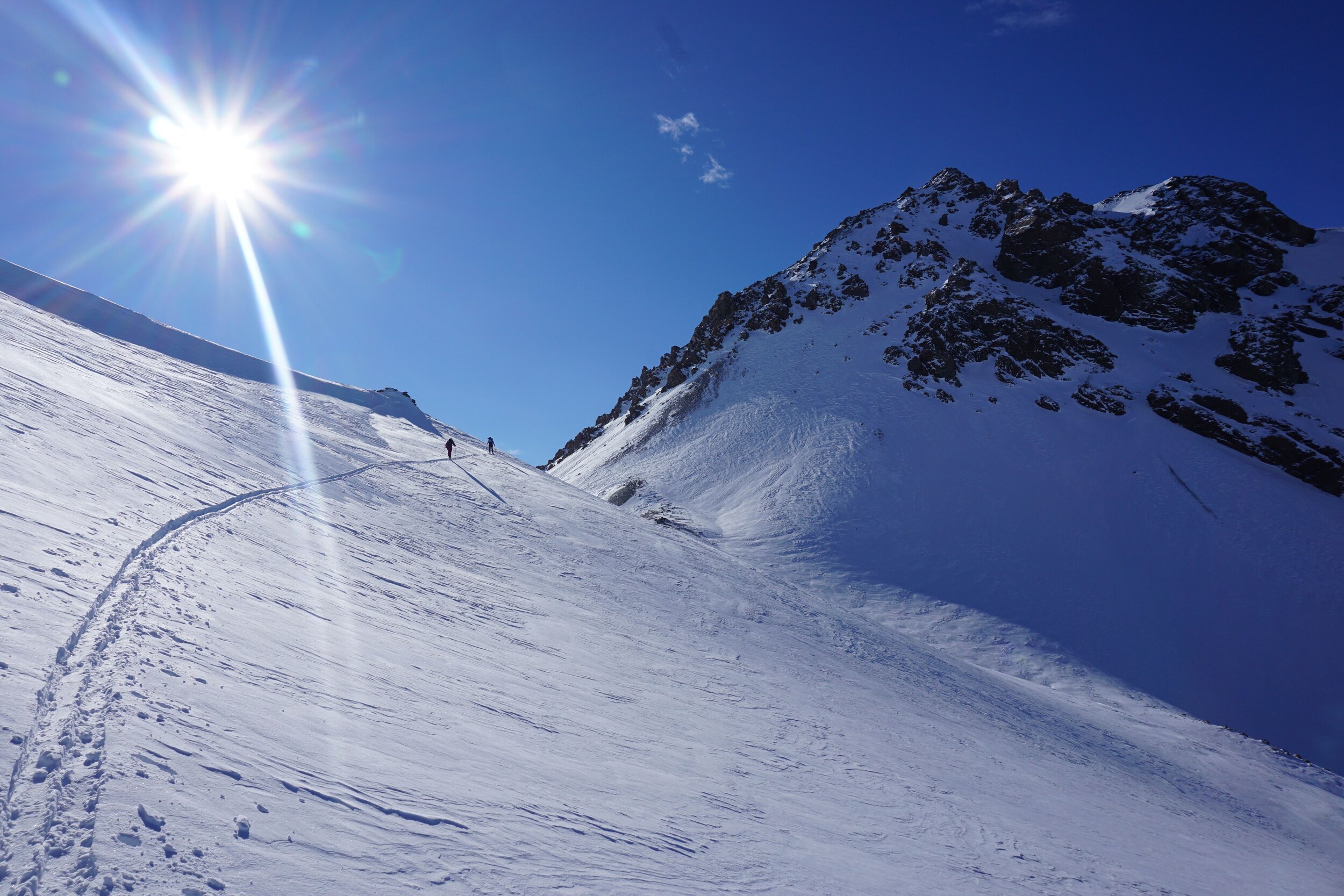
Track setting out of Tin Creek, August, 2019.

The powder turn, August, 2019.

Toyota Landcruiser Diesel named Tigger, Tin Hut, New Zealand, August, 2019